
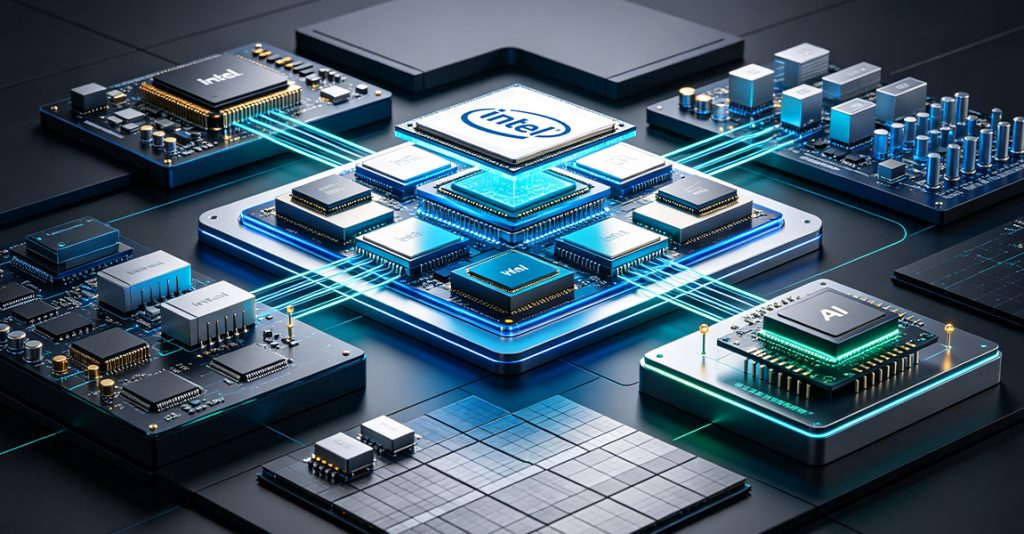
This week’s semiconductor stock spotlight is Intel ($INTC)
Intel is one of the most recognizable semiconductor companies in the world. Founded in 1968 and headquartered in Santa Clara, California, the company spent decades defining the personal computer and server processor markets. However, today’s Intel is no longer simply a CPU manufacturer. Under the leadership of CEO Lip-Bu Tan, the company is rebuilding itself around client chips, data center processors, artificial intelligence, advanced packaging, and Intel Foundry, with the goal of combining chip design and advanced manufacturing into a renewed competitive advantage. In the second quarter of 2026, Intel generated $16.1 billion in revenue, representing 25% year-over-year growth and its strongest quarterly revenue growth in more than fifteen years.
If you believe Intel’s entire story depends only on a recovery in the PC market, you may be overlooking the larger transformation taking place. Artificial intelligence does not eliminate the need for CPUs. AI workloads, cloud computing, databases, enterprise software, and everyday computing tasks still require powerful general-purpose processors. As AI models expand, the amount of data processed across infrastructure continues increasing, creating new demand for CPUs alongside specialized accelerators. In the second quarter of 2026, Intel’s Data Center and AI business generated $6.3 billion in revenue, growing 59% year over year as server demand strengthened.
The biggest challenge investors have focused on in recent years has been Intel’s position in advanced manufacturing compared with competitors such as TSMC. However, the key question now is whether Intel can successfully rebuild its process technology leadership. Intel 18A entered production in 2025, introducing RibbonFET gate-all-around transistor technology and PowerVia backside power delivery. By 2026, the enhanced Intel 18A-P process entered risk production, while the next-generation 14A process began advancing with customers. For Intel, 18A represents more than a new manufacturing node; it represents a critical opportunity to prove that the company can once again deliver world-class semiconductor manufacturing.
This technology is also moving beyond development stages and into commercial products. Intel’s Core Ultra Series 3, also known as Panther Lake, became the first major AI PC platform built on Intel 18A technology, supporting more than 200 device designs. The company also introduced Xeon 6+ data center processors based on the new process technology, extending Intel’s manufacturing progress from consumer devices into enterprise infrastructure. At the same time, Intel Foundry is becoming another important part of the company’s strategy, with second-quarter revenue reaching approximately $5.8 billion, up 31% year over year, while operating losses narrowed compared with the previous year.
Advanced packaging is another area where Intel is positioning itself for future growth. As AI chips become increasingly complex, future semiconductor designs may rely on combining different chiplets rather than building everything on a single process node. Intel’s Foveros technology and advanced packaging capabilities allow different computing components to work together more efficiently. As AI infrastructure evolves, the ability to connect processors, accelerators, and memory may become just as important as transistor manufacturing itself.
Financially, Intel’s recovery is becoming more visible. In the second quarter of 2026, the company generated $16.1 billion in total revenue, with Client Computing revenue reaching approximately $8.9 billion and Data Center and AI revenue reaching $6.3 billion. Operating cash flow reached $7 billion, while management expected third-quarter revenue between $15.8 billion and $16.8 billion. The company has also continued restructuring efforts, reducing organizational complexity and focusing resources on core areas including client products, servers, advanced manufacturing, and Foundry operations.
Intel’s current market attention is not based on already reclaiming industry leadership, but on several major changes happening at the same time: Intel 18A moving into production, AI PC platforms entering the market, data center growth returning, Foundry losses narrowing, and advanced manufacturing becoming increasingly important globally.
For years, the market viewed Intel as a semiconductor company that had lost its advantage.
But the semiconductor industry has always been defined by technological shifts, where a successful process node, a strong product generation, or a major manufacturing breakthrough can reshape competitive positions.
NVIDIA is defining AI acceleration, while TSMC continues leading advanced foundry manufacturing.
Intel is attempting something more complex: proving that one company can once again combine CPU technology, AI computing, advanced processes, semiconductor manufacturing, and advanced packaging.
If this transformation continues successfully, the market may eventually evaluate Intel not only by the processors it sells, but by whether it can become one of the most important platforms in the future of advanced semiconductor manufacturing.